
(Note: This blog contains links that open in a new tab. One of the links is a PDF download. The PDF download is indicated in parenthetical text. There are no sales/affiliate links in this blog post.)
Here, we go. Hi. Hi. Um. My name is Jane and I’ll be your instructor here today for …Uh … beginner’s Jin Ku Pao. So, let’s just get right into it. Here we go!
Those are the lines Téa Leoni gave as the character Jane in the 2005 dramedy “Fun with Dick and Jane” co-starring Jim Carrey; both of whom were attempting to recoup lost income after Jim’s character, Dick, lost his high-paying corporate job. “Dick” took a job as a greeter at a wholesale club, and “Jane” took a fitness instructor’s position for a course she didn’t know how to teach. Spoiler: They both quit/got fired after the first day.
This is what happens when you hire people who may look the part but fail to know the content of their jobs.
Jane needed the money. She took a position to teach content about which she knew nothing and left her students physically injured and in dispute.
It is a humorous scene that skips between her mishaps and those of her husband on the same workday. But what makes “Fun with Dick and Jane” a dramedy is that amid the laughter is the reality of mishires ruining products and companies.
Black Studies as the Study of the World Curriculum
I thought: ‘Who hired Jane?’ when I read the 6th Grade Lesson Plans as part of the Black Studies as the Study of the World Curriculum Guide released in October 2024 by the New York City Department of Education. A project funded with more than $8 million to BERC (Black Education Research Center) of Columbia University’s Teachers College to create the document and conduct teacher training with a few other New York City entities.
Sixth is the grade in which US students learn about Kemet (Ancient Egypt). In the UK, it is 2nd or 3rd grade.
In 2020, I co-founded Kemet Nubia Kamp with three other cofounders, one being Egyptologist Dr. Sally-Ann Ashton, who was recently featured in the “Queen Cleopatra” Netflix show, to create primary and secondary lessons and teacher professional development workshops centered on the Nile Valley Civilizations. Our two other founders are long-time Egypt Search forum, the oldest Egyptian history forum on the web, administrator Donn Cooks, and Sudanese-Nubian activist & founder of the Nubia Project Mayada Mannan. As for me, I am a former New York City Public School teacher. But more relevant to this discussion, I have been writing and teaching about the ancient Nile Valley for decades. I have more than 1.7 million views on about 200 responses, mostly about Kemet, on Quora.
We reached out to BERC via email in Summer 2022 requesting a meeting. They responded with initial interest; their team was copied; we sent them a one-pager and team bios, samples of our work not visible to the public. But they never had a meeting with us.
The reason for our outreach is because Kemet, Kush, Axum, and lessons on the ancient Nile Valley Civilizations (and ancient Africa, in general), have always been poorly presented. They lacked content, clarity, and accuracy. We wanted historical accuracy. We wanted to prevent another calamity. Instead, what NYC DOE published is another Jin Ku Pao disaster.
The essential question for the 6th-grade section is: “In what ways have people in power influenced people’s rights and freedoms?”
The NYC Public School’s Social Studies standards cited are ones centered on the first humans of the Neolithic in the Eastern Hemisphere (6.2), the use of archaeology to investigate history (6.2d), present-day Eastern Hemisphere geography (6.1), human populations on waterways (6.1b), Eastern Hemisphere river valley societies from c. 3500 BCE to 500 BCE (6.3), political and social hierarchies impacting access to power, wealth, and jobs (6.3d), societies developing shared customs, beliefs, ideas, and languages (6.3a), societies adapting their environments to meet the needs of their population (6.3c), and comparative world religions from c. 2000 BCE to 630 CE in the Eastern Hemisphere (6.4).
As for the essential question and social studies standards, those are the best parts of the unit. Below are three among several more errors in the Ancient Egypt/Classic Nile Valley curricula.
Anonymous sources, few — if any — artifacts of historical figures, & confusing narratives for Ancient Egyptian content
What follows, however, is a series of outward-bound links to other sources such as a link to the African History website that uses Greek place names for “Egyptian” locales and “Egyptian” rulers who were Meshwesh (Libyan) in ethnicity. The article attempts to explain how Nubia conquered “Egyptians,” but “Egypt” was already foreign-ruled at this point. The article describes places using Greek, English, and Arab-named municipalities even though these battles occurred long before Greeks, Arabs, and English were in the land. The narrative is difficult to follow for those who know and those who do not know the history given there are no maps to show where Nubia’s border began — which in modern-time was just south of Aswan, Egypt— and where the battles between the Napatan-ruler Piye fought the Meshwesh (Libyan) kings such as Iuput II and Osorkon IV.
The article is full of modern-day graphics alluding to a general population of lighter, skin-toned “Egyptians” as compared to darker, skin-colored Nubians. It does not use artifacts to show the depictions of the people named in the historical account. In reality, the Napatan (Nubian) civilization and the Meshwesh (Libyan-Egyptian) civilization dressed similarly and looked the same.
Two of the “Egyptian” (Meshwesh/Libyan) rulers defeated by Piye:
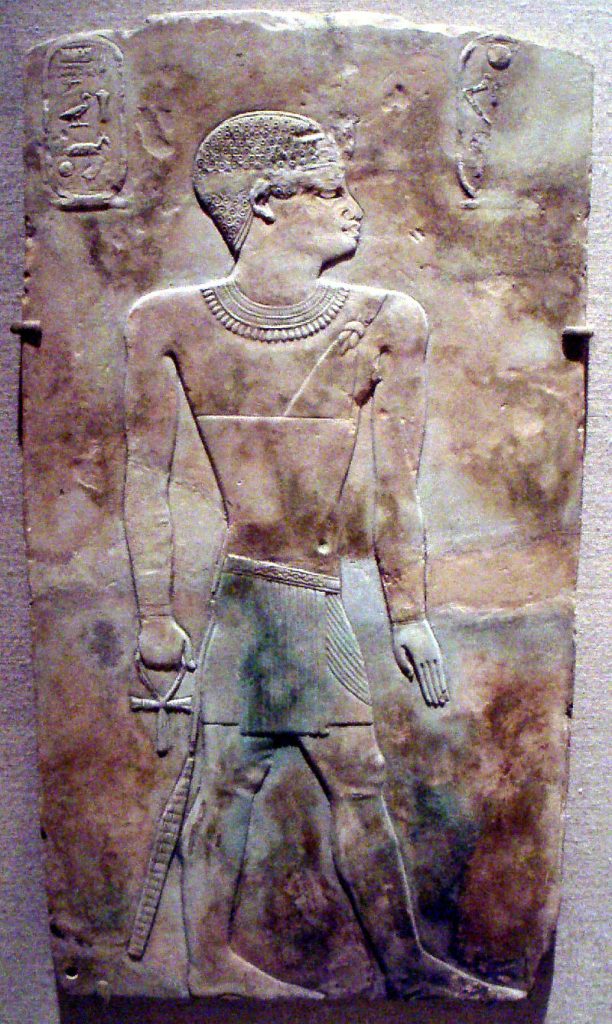
The work Thebes in the First Millennium BCE (This links to a PDF File.) identifies an artifact as Osorkon IV, the Libyan ruler of Kemet also defeated by Piye. Osorkon IV (or Osorkon III) also has been identified in another artifact from Djanet (Tanis), the capital city of two of the Libyan Dynasties from an El Mundo science article on the ruins of Tanis by Francisco Carrión:
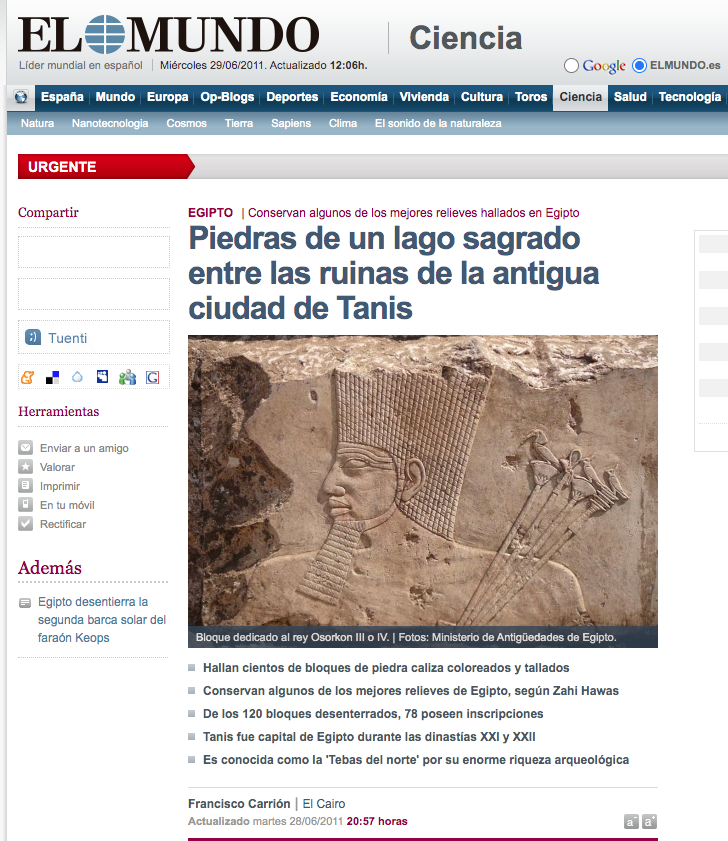
There are no statues of Piye but other artifacts from the Kushite (Nubian) rule of Kemet that followed the Meshwesh (Libyan) rulers do exist. The Meshwesh kings rule for nearly 200 years spanning the 22nd through the 24th Dynasties.
One of the most famous 25th Dynasty (Nubian dynasty) kings is the ruler Taharka. A less-shown 25th Dynasty artifact is that of Prince Horemakhet. The Nubian dynasty lasted about 120 years.
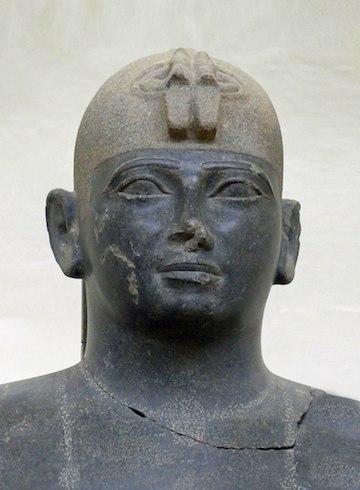
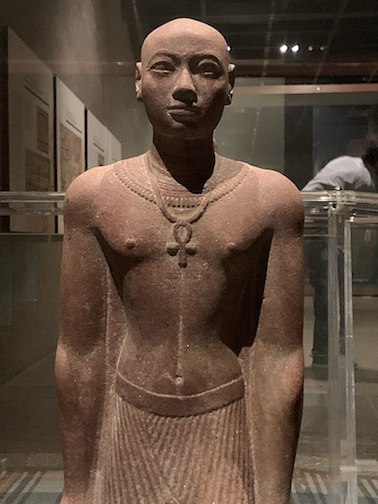
Within its context, the fight over the lands of Kemet (Ancient Egypt) leading to the 25th Dynasty’s origin was among two rivals — Libyans and Nubians — who did not have phenotypic differences. Moreover, the Nubians had the same religious practices as earlier Kemety (Ancient Egyptian native) dynasties such as the 18th through 20th Dynasties, and the Libyans introduced new deities within their rule of Kemet since their origins were West of Kemet. Both of these groups were Africans and also composed of ethnic groups within Kemet since its formation even when Libyans and Nubians were not among the ruling class of previous dynasties.
This 2024 curriculum repeats the same error of previous works that Nubians were “the Blacks” who conquered “Egypt” but disregards facts such as the “Egypt” they conquered was already ruled by foreign Libyans who were also Black, and the civilization wasn’t named “Egypt” at all because Greeks were not among the civilization’s founders.
A serious edit is needed to delete all illustrations. Replace those illustrations with artifact photographs as I have done above. Caption the photographs. Replace the Greek location names with their Kemety (Ancient Egyptian) names then place the Greek, Arab, or English names parenthetically should have been the editorial standard. It’s the standard we use. We know the names because they are on the artifacts. Finally, they should create a few maps showing the then border of Nubia and the locations of the territories would help some students visualize where all these disputes, land losses/grabs, etc. have occurred. There’s too much text describing locations foreign to American students without maps.
Ironically, the Black Studies curriculum drafters have a lesson devoted to determining factual sources. Yet, their link is to this blog without an author’s name. Every blog post is generically written by “The African History” and many blog entries are “illustrated” by AI-generated art. There is no “About page” to identify “who” the writers are.
What lessons are being taught by this example?
Jane says, “Jab. Jab.”
Still, the outbound link above is better than what follows. It gets worse.
Projects and content inexplicable shifts to the Western Hemisphere, and sourcing an article from a blog repurposing another’s content.
There’s a project with a link to the mass shooting in Buffalo, NY that is out of context with this unit. Other lessons include links for students to listen to music by Jazz artist Jon Baptiste as well as Kendrick Lamar and Beyonce. Music that is more suited for American history especially since the unit standards are about the Eastern Hemisphere and not the Western Hemisphere. I get it: Text to self. However, there is more relevant news and music from the Eastern Hemisphere that should have been used to remain within the Social Studies standards.
They oddly link to an article on the Ancient Origins website of Axum (Aksum) that offers little in terms of Axumite history since the short article is about some gold jewelry traded to Rome and the blog entry copies from what originally appears in an article from The Guardian publication and other sources. One has to wonder why the link wasn’t directly to the Guardian article since it is the work of a different person. So, instead of linking to the source article, they linked to a blog writer who derived work/copied The Guardian’s article.
The Ancient Origins blog entry was authored by April Holloway (the pen name of Joanna Gilian) who co-founded the site with her husband. Gilian has a degree in educational psychology, has worked with autistic children, and has worked for the British royal family. Her blog entry did have a map but essentially was unoriginal. Moreover, Ancient Origins, the blog, is an odd source to cite since the website frequently posts lots of other blog entries on “aliens” and “alien theories.” Just put “alien” in their search engine and one can see their numerous blog results.
So, in summary, not the best source, and not a good article from that source. It may have been better to focus on Axumite to Christianized Axum and cover the art of that period by way of another source, such as the Met Museum’s account of Axum or, at the very least, a self-hosted summary of the Met’s account.
Jane says, “…and punch, and punch, and step and kick.” She accidentally kicks a student and knocks her down.
Stating a name for the Nile River that is not factual
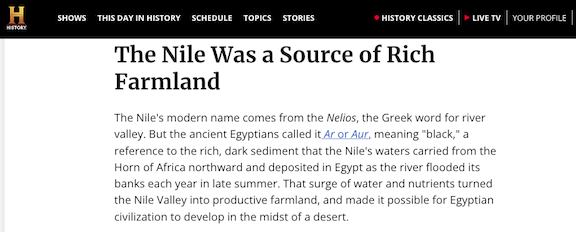
By far, no graver mistakes were made than by the History.com linked article entitled “Why the Nile River was so Important to Ancient Egypt.” That piece just invented “a fact” that was, in fact, not a fact.
Unfortunately, Google’s AI software has added this non-fact to its generated responses under the real fact that the Nile River was called H’py/hApy by the rmTw (Ancient Egyptians).
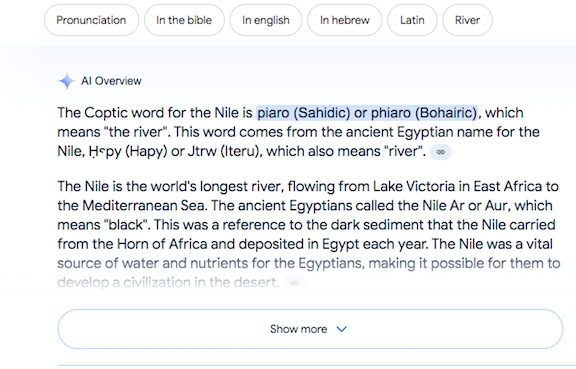
There is no vocabulary word in any of the “Ancient Egyptian” dictionaries by EA Wallis Budge or Mark Vygus that has Ar or Aur to mean anything much less words for the colors of black or the Nile River. The word for the Nile River is the same word for their deity that represents the inundated Nile, it’s H’py. There are many different vocabulary words for canals, river mouths, lakes, etc. in these same dictionaries but none are what is claimed so definitively in the History.com article penned by Patrick J. Kiger whose bio does not mention anything about expertise in Kemet’s (Ancient Egypt’s) history.
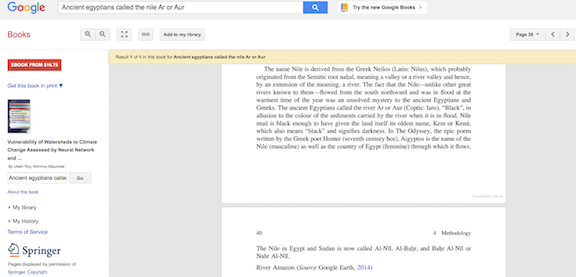
Kiger’s source for the vocabulary fails to use any citation for how or why they have determined Ar or Aur is the original name for the Nile in their book or that means the color black. The Coptic words for river are “piaro” or “phiaro” in the two major Coptic dialects, not “iaro” as the source below states, and neither of those words are the rmTw (Ancient Egyptian) words for “river” or “black” color.
EA Wallis Budge & Mark Vygus’ name for the Nile is Hapy
The dictionaries many Egyptologists use for reference have the actual names and references.
E.A. Wallis Budge:
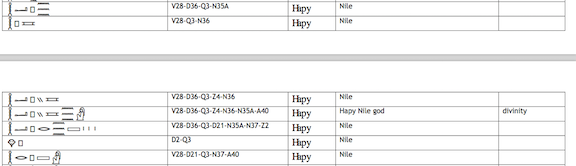
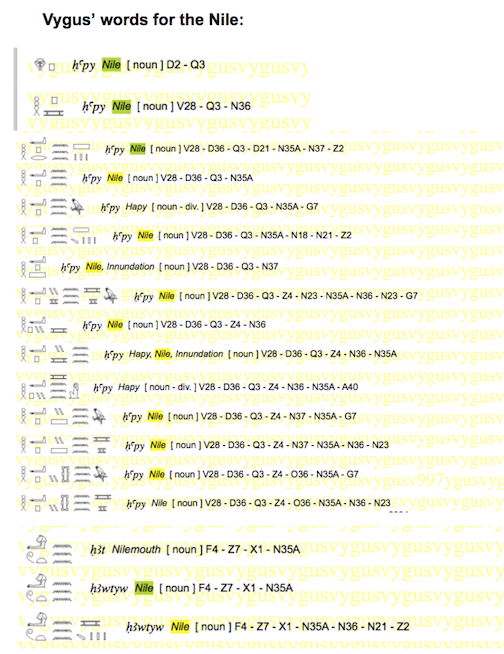
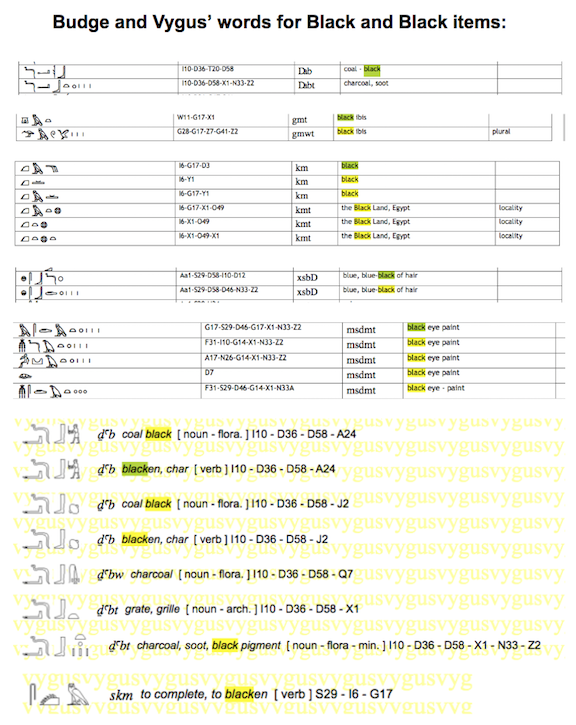
There is no Aur/Ar term for the color Black either
As for the color black, while “km” is one word for the color black, note that other words were used for the color of certain black items and none are this Ar/Aur claim. Here are Vygus and Budge together:
Spending millions of dollars for poorly researched and drafted lessons
Some may argue: What is the big deal about a few poorly drafted summaries and renaming of the Nile River to a word that was never its name?
The big deal is New York City gave more than $8 million to Columbia University to draft a Black Studies curriculum for its public schools that included Kemet, Nubia/Kush, and Axum/Aksum but overwhelmingly the sourced content for those lessons were drafted by people knowing little to nothing about the civilizations and that is part of the reason the errors are so plentiful.
How does one hire no Black people to lead the curriculum development in this area for a Black Studies project?
Stop paying Dick and Jane. Their work is substandard and creates a disaster.
Dick leaves the store yelling at security that he’s glad he’s fired because the position didn’t pay a living wage. He remotely unlocks his BMW, casually saying: ‘It’s a lease.’
Jane exits the gym, towel over her head, sunshades hiding her eyes, as her students fight inside the fitness center.
Dick took for granted that his corporate experience would translate to grocery store retail success. He lacked skills in assessing and acclimating to the new job’s culture. Jane wasn’t an instructor of Jeet Kune Do, the real name of the martial arts form she renamed when starting the class. It’s the martial arts form that Bruce Lee created, and her students expected.
The NYC Department of Education’s Black Studies curricula team failed to hire curriculum developers knowledgeable of the 6th-grade ancient Nile Valley content.